Medicare’s popular program, offering free gym membership and health education.

Once you turn 65, the world of Medicare opens to you, and you also gain access to its offshoot supplemental programs. You likely know about Part A, Part B, Medicare Advantage, and other sections, but you may not know about the senior fitness offering “SilverSneakers.”

SilverSneakers is a versatile and free fitness plan for Medicare recipients. Not every insurance company that has Medicare Advantage or other Medicare Supplement Insurance plans has SilverSneakers as a choice. But it’s definitely worth asking about whenever you add or change your coverage.

SilverSneakers grants free access to thousands of fitness locations across America. Call ahead to find out if your local gym participates. You might also inquire if their location offers special SilverSneakers classes. These fitness sessions are designed for Medicare-aged students.

Not all SilverSneakers’ benefits are centered around the gym, however. For those who prefer different types of exercise, FLEX, a feature within SilverSneakers, holds meetups at community centers, public parks, and places of worship. They provide fitness opportunities that might not be available at your gym, such as hiking groups, yoga, and swimming.

SilverSneakers also offers health seminars, wellness events, and other community-building options for their members. The emphasis is on getting engaged and getting moving.

Remember, though, that not all plans offer SilverSneakers. Communicate carefully when doing your research and make a selection that covers your needed treatments and prescriptions first. Any extras should be secondary. It’s also important to remember that SilverSneakers’ availability may vary from year to year and even be canceled to make room for other features. Make your decisions with that knowledge and your overall health needs in mind.

The content is developed from sources believed to be providing accurate information. The information in this material is not intended as tax or legal advice. It may not be used for the purpose of avoiding any federal tax penalties. Please consult legal or tax professionals for specific information regarding your individual situation. This material was developed and produced by FMG Suite to provide information on a topic that may be of interest. FMG, LLC, is not affiliated with the named broker-dealer, state- or SEC-registered investment advisory firm. The opinions expressed and material provided are for general information, and should not be considered a solicitation for the purchase or sale of any security. Copyright FMG Suite.

Use this handy calendar to remember the year’s most important financial dates.

JANUARY: Get ready for a brand new year.

  • Write down the major financial events you anticipate in the next few years. That will help guide a discussion about whether your portfolio reflects your short- and long-term goals.
  • Update your personal net worth to account for any significant changes in the past year.
  • Double-check your employer-sponsored retirement plans. When determining how much to contribute, make certain to check whether your employer offers a matching program.

FEBRUARY: This month, don’t forget your financial check-up.

  • Take a moment to check on your various insurance programs and coverage amounts. Draw up a list of questions if you believe they no longer reflect your lifestyle.
  • Create a list of your top-three major expenses scheduled for the year.
  • Take a minute and create a list of your monthly subscription services.

MARCH: Spring into spring.

  • You should have received most of your tax documents by now. Start organizing your important documents so you can complete your federal and state returns.
  • Check your credit report. All U.S. Citizens are entitled to a free copy of their credit report every 12 months from the national credit reporting agencies.

APRIL: Tax time is the right time.

  • Tax returns are typically due before midnight of April 15. If you need to request a six-month extension, you still need to pay any taxes due by April 15.
  • April 15 is also the last day to contribute to most retirement accounts for the prior year.
  • Don’t forget that first-quarter estimated income tax payments are due by April 15.

MAY: It’s summertime, and financial prep is easy

  • Create or update your home and personal property inventory. Use your phone and reliable digital-backup service to record and store videos of your valuable possessions.
  • Take a look at your estate strategy, and see if it continues to reflect your family’s wishes. Were there any marriages or divorces in the past year? Did your family welcome a new child or grandchild?

JUNE: We’re halfway to next year.

  • Take a look at your “sources and uses” of money. Is it what you expected, or are you considering making adjustments?
  • Don’t forget second-quarter estimated income tax payments are due by June 15.

JULY: Review the year so far.

  • Refresh your money skills. Add at least one book on personal finance, economics, or investing to your summer reading list.
  • Look back at the last 6 months. Are there any financial takeaways you can apply to the remainder of the year?

AUGUST: It’s time to go back to school.

  • As children or grandchildren get ready for school, create a strategy to help pay for the expenses. There are a number of educational funding choices, and one may be a fit for your situation.

SEPTEMBER: Sweater weather has arrived.

  • Most companies begin “open enrollment” for their insurance plans in the following months. Prepare now by looking at your current health plan and considering whether it meets your needs. Open enrollment for Medicare starts in November.
  • Check your credit card benefits and points earned. With holidays around the corner, you may be due a deal.
  • Don’t forget third-quarter estimated income tax payments are due by September 15.

OCTOBER: Don’t forget to prepare for trick-or-treaters.

  • If you have children off to college next year, the Free Application for Federal Student Aid (FAFSA) window opens once again on October 1. Encourage your child to complete the FAFSA as early as possible to increase their chances at available scholarships and grants.
  • File your income tax return by October 15 if you requested a six-month extension back in April.
  • If you want to establish a retirement plan outside of your work-sponsored program, you must open the account by your tax filing deadline plus any extensions, which is October 15 for most.
  • Medicare open enrollment begins, providing your opportunity to drop or switch plan coverage.

NOVEMBER: The perfect month to give thanks.

  • Review your charitable giving and update any funding strategies, if needed.
  • Watch for capital gains payouts. Investment companies typically distribute capital gains in December, and by November, they usually publish estimates of their distributions.
  • Healthcare.gov open enrollment begins, Medicare Part A and B premiums and deductibles announced.

DECEMBER: End the year full of ope and goodwill.

  • If you’re 73 or older, don’t forget to take your annual required minimum distribution (RMD) by December 31.
  • You can request an annual Social Security Statement. Compare your earnings record against your old tax returns for accuracy. This is also an excellent time to check for other irregularities to prevent identity theft.
The content is developed from sources believed to be providing accurate information. The information in this material is not intended as tax or legal advice. It may not be used for the purpose of avoiding any federal tax penalties. Please consult legal or tax professionals for specific information regarding your individual situation. This material was developed and produced by FMG Suite to provide information on a topic that may be of interest. FMG, LLC, is not affiliated with the named broker-dealer, state- or SEC-registered investment advisory firm. The opinions expressed and material provided are for general information, and should not be considered a solicitation for the purchase or sale of any security. Copyright FMG Suite.

Social media may be a modern imperative for businesses looking to grow and build their brand, but it also introduces risk.

The stories of social media fails are legendary—companies using inappropriate humor regarding serious social issues, typographical errors, and pop references that backfire.

These examples represent reputational issues that can affect your company’s brand and its sales.

The mistakes in social media marketing that make the headlines can obscure other forms of risks presented by social media, namely privacy violations, security breaches, unauthorized use of intellectual property, and employment-based claims, among others.1

Liability Risks of Social Media

The risks that social media may introduce to your business are generally not new, but conventional risks delivered in a modern way.

To help manage these risks, you should:

Create a general social media policy for your company
Develop a specific policy for employees who use social media as part of their role
Consider a policy that also addresses personal social media use outside of work
Don’t create your policy in a vacuum. Rely on the diverse talents of your employees
Limit social media to designated spokespersons for better control over messaging
Train all employees on your social media policies

These risks may be covered by your existing business liability insurance, provided through a rider on your current policy or through the purchase of specialized coverage. Speak with your insurance agent to learn how to make sure you are adequately protected against the business risks of social media.

1. The information in this material is not intended as legal advice. Please consult legal or insurance professionals for specific information regarding your individual situation.
The content is developed from sources believed to be providing accurate information. The information in this material is not intended as tax or legal advice. It may not be used for the purpose of avoiding any federal tax penalties. Please consult legal or tax professionals for specific information regarding your individual situation. This material was developed and produced by FMG Suite to provide information on a topic that may be of interest. FMG, LLC, is not affiliated with the named broker-dealer, state- or SEC-registered investment advisory firm. The opinions expressed and material provided are for general information, and should not be considered a solicitation for the purchase or sale of any security. Copyright FMG Suite.

Knowing how insurance deductibles work can help you save money.

An insurance deductible is the amount you, the insured, pay before any claim is paid by your insurance carrier. Depending upon the type of insurance, a policy may set the amount of deductible, or offer you the ability to select a deductible amount.

Deductibles serve a dual purpose: they save the insurance company money (including the administrative cost of processing small claims) and may help keep your premium costs lower.

Choosing the Right Deductible Amount

Generally speaking, the trade-off between deductible levels and insurance premiums is simple: The higher the deductible, the lower the cost of insurance. Conversely, the lower the deductible, the higher the cost of insurance.

Deciding how to make that trade-off is a function of math and your own comfort level with higher out-of-pocket costs if you choose a higher deductible.

Only you can decide if saving $65 a year in premiums for a deductible that is $500 rather than $200 is worth it to you. You may find that the relationship between deductible amount and premium cost is different depending upon the type of insurance. For instance, the savings with a higher deductible may be significant with auto insurance, but much less so with homeowners insurance.1

Not only will this relationship between deductibles and premiums differ based on insurance type, but it may differ based upon other factors, such as your age and the value of your car, for example.

When you consider the appropriate deductible level for health insurance coverage, remember that deductibles may be on each member of the family.

When shopping for insurance, you should always ask your insurance agent what the premium costs are at each of the available deductible levels. Knowing that information may help you make a sound decision regarding your coverage.

1. For illustrative purposes only. This example is not meant to indicate any actual relationship between deductible amount and insurance premium cost.
The content is developed from sources believed to be providing accurate information. The information in this material is not intended as tax or legal advice. It may not be used for the purpose of avoiding any federal tax penalties. Please consult legal or tax professionals for specific information regarding your individual situation. This material was developed and produced by FMG Suite to provide information on a topic that may be of interest. FMG, LLC, is not affiliated with the named broker-dealer, state- or SEC-registered investment advisory firm. The opinions expressed and material provided are for general information, and should not be considered a solicitation for the purchase or sale of any security. Copyright FMG Suite.

How HSAs and FSAs might help your household.

With family health insurance premiums rising 297 percent since 2000, averaging over $25,000 annually, some employees feel the squeeze. Deductibles, too, have jumped nearly 50 percent over the last decade, further increasing out-of-pocket expenses. In this environment, understanding and using Health Savings Accounts (HSAs) and Flexible Spending Accounts (FSAs) can help families take more control of their healthcare finances.1

What Are HSAs and FSAs?

HSAs and FSAs are special accounts designed to help manage medical expenses.

If you have an HSA, you must also be enrolled in a high-deductible health plan (HDHP). You contribute to the account, and your employer can also choose to contribute. Funds roll over from year to year.

FSAs are usually employer-sponsored accounts. You contribute pretax dollars through payroll deductions. However, the funds must typically be used within the plan year unless your employer offers a grace period or limited rollover.

Both accounts allow you to use pretax dollars to pay for qualified medical expenses, such as copays, prescriptions, or over-the-counter medications. The one that may be best for you can depend on many factors.

Key Differences Between HSAs and FSAs
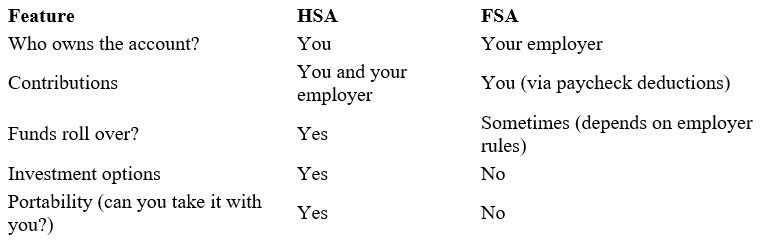
HSA FSA Chart

Contribution Limits:

For 2025, the IRS allows individuals to contribute up to $4,300 and families up to $8,550 to an HSA. People over 55 can contribute an extra $1,000 annually. The FSA has a contribution limit of $3,300 ($6,600 for households).2,3

Why These Accounts Matter More Than Ever

Rising premiums and deductibles mean Americans are shouldering more health care costs than ever. Since 2000, workers’ out-of-pocket costs for health insurance have nearly quadrupled. Today, it takes over five weeks of full-time work to pay the employee share of premiums, and this is before a single doctor’s visit. Moreover, deductibles for families can exceed $3,700.1

Employers are also increasingly shifting healthcare costs to workers through narrower provider networks, more prior authorizations, and tiered drug pricing systems. That’s where HSAs and FSAs come in. By allowing workers to set aside pretax money, these accounts help manage healthcare costs and create a strategy for expected and unexpected expenses.

Remember that if you spend your HSA funds for non-qualified expenses before age 65, you may be required to pay ordinary income tax and a 20 percent penalty. After age 65, non-qualified expenses are taxed as ordinary income taxes on HSA funds, and no penalty applies. HSA contributions are exempt from federal income tax but not from state taxes in certain states.

Real-Life Scenarios Where HSAs and FSAs Help

  • Having a Baby: New parents can face an increase in health-related costs, ranging from prenatal care and delivery to postnatal checkups and baby essentials. An FSA can help cover many of these expenses with pretax funds, whereas an HSA can carry over unused funds for future pediatric visits.
  • Job Change: Moving to a high-deductible plan may make you eligible for and your HSA funds remain yours even if you switch employers or retire, making it a flexible long-term tool.
  • Chronic Illness Diagnosis: Copays, prescriptions, and specialist visits add up quickly. An HSA or FSA can manage the blow, and an HSA with investment options that are available with some plans.
  • Caring for Aging Parents: From prescriptions to home health aides, caregiving costs can be significant. FSAs can help cover some expenses, and for those with HDHPs, an HSA provides a long-term strategy for health-related caregiving costs.

Other HSA/FSA Tips

  • Use online calculators to see what might work for you.
  • Prepare for known medical expenses to use funds strategically.
  • Monitor your balances online and review your list of eligible expenses.
  • If you have an HSA, see if there is an investment option associated with the account.

Remember: during any qualifying life event, like marriage, a new child, or a job change, review your options because these events may allow you to enroll in or adjust your benefits outside Open Enrollment.

Final Thoughts

Understanding how HSAs and FSAs work and using them effectively can make a meaningful difference during life’s most important transitions.

If you haven’t explored these options, now may be the time to start.

1. MoneyGeek, April 29, 2025.
2. Kaiser Permanente, June 2, 2025.
3. IRS, May 29, 2025.

The content is developed from sources believed to be providing accurate information. The information in this material is not intended as tax or legal advice. It may not be used for the purpose of avoiding any federal tax penalties. Please consult legal or tax professionals for specific information regarding your individual situation. This material was developed and produced by FMG Suite to provide information on a topic that may be of interest. FMG Suite is not affiliated with the named broker-dealer, state- or SEC-registered investment advisory firm. The opinions expressed and material provided are for general information, and should not be considered a solicitation for the purchase or sale of any security. Copyright FMG Suite.

Loss of income from disability has the potential to cause financial hardship. Disability insurance can help.

According to the Social Security Administration, a 20-year-old has more than a 25% chance of becoming disabled before reaching retirement age.1

Loss of income for such a duration has the potential to cause significant financial hardship. And while Social Security Disability Insurance may help, it’s critical to understand that about two-thirds of initial applications are denied and the average SSDI payment is only $1,580 a month.2,3

Disability coverage may be available through your employer, who may pay all or a portion of the cost for your coverage.

Employer plans typically pay up to 60% of your income. This limited coverage might not be enough to meet your bills, which is why you may want to supplement employer-based coverage with a personal policy.4

Taxation of Disability Benefits

When you purchase a personal disability policy, the benefit payments are structured to be income tax-free. Consequently, you may not be eligible for coverage that equals your current salary since your take-home pay is always less.

If your employer paid for your coverage, then the income you receive generally will be taxable. If you paid for a portion of the employer-provided coverage, then the pro rata amount of the benefits you receive are structured to be tax-free.

Choices, Choices, Choices

Consider the waiting period before disability payments begin. A longer waiting period saves you money, but it also means that you may have to live off your savings for a longer period. You are the best judge of how much of this risk you are comfortable assuming.

You also may want to coordinate the waiting period with any short-term disability benefits you could have. For example, if your short-term disability covers you for 90 days, look to have at least a 90-day waiting period so that you can potentially lower the cost of the long-term policy.

Ask how a policy defines an inability to work. Some policies will say “the inability to do any job or task;” others will say “own occupation.” You may prefer the latter definition so you’re not forced to perform some less-skilled, lower-paid work. That type of work may not help you meet your bills.

1. SSA.gov, 2025
2. Disability-Benefits-Help.org, 2025
3. SSA.gov, 2025
4. III.org, 2025
The content is developed from sources believed to be providing accurate information. The information in this material is not intended as tax or legal advice. It may not be used for the purpose of avoiding any federal tax penalties. Please consult legal or tax professionals for specific information regarding your individual situation. This material was developed and produced by FMG Suite to provide information on a topic that may be of interest. FMG, LLC, is not affiliated with the named broker-dealer, state- or SEC-registered investment advisory firm. The opinions expressed and material provided are for general information, and should not be considered a solicitation for the purchase or sale of any security. Copyright FMG Suite.
css.php