Knowing how insurance deductibles work can help you save money.

An insurance deductible is the amount you, the insured, pay before any claim is paid by your insurance carrier. Depending upon the type of insurance, a policy may set the amount of deductible, or offer you the ability to select a deductible amount.

Deductibles serve a dual purpose: they save the insurance company money (including the administrative cost of processing small claims) and may help keep your premium costs lower.

Choosing the Right Deductible Amount

Generally speaking, the trade-off between deductible levels and insurance premiums is simple: The higher the deductible, the lower the cost of insurance. Conversely, the lower the deductible, the higher the cost of insurance.

Deciding how to make that trade-off is a function of math and your own comfort level with higher out-of-pocket costs if you choose a higher deductible.

Only you can decide if saving $65 a year in premiums for a deductible that is $500 rather than $200 is worth it to you. You may find that the relationship between deductible amount and premium cost is different depending upon the type of insurance. For instance, the savings with a higher deductible may be significant with auto insurance, but much less so with homeowners insurance.1

Not only will this relationship between deductibles and premiums differ based on insurance type, but it may differ based upon other factors, such as your age and the value of your car, for example.

When you consider the appropriate deductible level for health insurance coverage, remember that deductibles may be on each member of the family.

When shopping for insurance, you should always ask your insurance agent what the premium costs are at each of the available deductible levels. Knowing that information may help you make a sound decision regarding your coverage.

1. For illustrative purposes only. This example is not meant to indicate any actual relationship between deductible amount and insurance premium cost.
The content is developed from sources believed to be providing accurate information. The information in this material is not intended as tax or legal advice. It may not be used for the purpose of avoiding any federal tax penalties. Please consult legal or tax professionals for specific information regarding your individual situation. This material was developed and produced by FMG Suite to provide information on a topic that may be of interest. FMG, LLC, is not affiliated with the named broker-dealer, state- or SEC-registered investment advisory firm. The opinions expressed and material provided are for general information, and should not be considered a solicitation for the purchase or sale of any security. Copyright FMG Suite.

How HSAs and FSAs might help your household.

With family health insurance premiums rising 297 percent since 2000, averaging over $25,000 annually, some employees feel the squeeze. Deductibles, too, have jumped nearly 50 percent over the last decade, further increasing out-of-pocket expenses. In this environment, understanding and using Health Savings Accounts (HSAs) and Flexible Spending Accounts (FSAs) can help families take more control of their healthcare finances.1

What Are HSAs and FSAs?

HSAs and FSAs are special accounts designed to help manage medical expenses.

If you have an HSA, you must also be enrolled in a high-deductible health plan (HDHP). You contribute to the account, and your employer can also choose to contribute. Funds roll over from year to year.

FSAs are usually employer-sponsored accounts. You contribute pretax dollars through payroll deductions. However, the funds must typically be used within the plan year unless your employer offers a grace period or limited rollover.

Both accounts allow you to use pretax dollars to pay for qualified medical expenses, such as copays, prescriptions, or over-the-counter medications. The one that may be best for you can depend on many factors.

Key Differences Between HSAs and FSAs
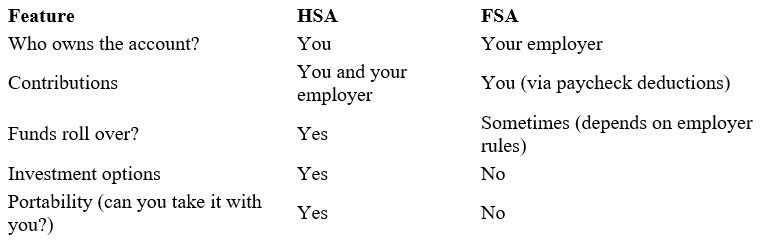
HSA FSA Chart

Contribution Limits:

For 2025, the IRS allows individuals to contribute up to $4,300 and families up to $8,550 to an HSA. People over 55 can contribute an extra $1,000 annually. The FSA has a contribution limit of $3,300 ($6,600 for households).2,3

Why These Accounts Matter More Than Ever

Rising premiums and deductibles mean Americans are shouldering more health care costs than ever. Since 2000, workers’ out-of-pocket costs for health insurance have nearly quadrupled. Today, it takes over five weeks of full-time work to pay the employee share of premiums, and this is before a single doctor’s visit. Moreover, deductibles for families can exceed $3,700.1

Employers are also increasingly shifting healthcare costs to workers through narrower provider networks, more prior authorizations, and tiered drug pricing systems. That’s where HSAs and FSAs come in. By allowing workers to set aside pretax money, these accounts help manage healthcare costs and create a strategy for expected and unexpected expenses.

Remember that if you spend your HSA funds for non-qualified expenses before age 65, you may be required to pay ordinary income tax and a 20 percent penalty. After age 65, non-qualified expenses are taxed as ordinary income taxes on HSA funds, and no penalty applies. HSA contributions are exempt from federal income tax but not from state taxes in certain states.

Real-Life Scenarios Where HSAs and FSAs Help

  • Having a Baby: New parents can face an increase in health-related costs, ranging from prenatal care and delivery to postnatal checkups and baby essentials. An FSA can help cover many of these expenses with pretax funds, whereas an HSA can carry over unused funds for future pediatric visits.
  • Job Change: Moving to a high-deductible plan may make you eligible for and your HSA funds remain yours even if you switch employers or retire, making it a flexible long-term tool.
  • Chronic Illness Diagnosis: Copays, prescriptions, and specialist visits add up quickly. An HSA or FSA can manage the blow, and an HSA with investment options that are available with some plans.
  • Caring for Aging Parents: From prescriptions to home health aides, caregiving costs can be significant. FSAs can help cover some expenses, and for those with HDHPs, an HSA provides a long-term strategy for health-related caregiving costs.

Other HSA/FSA Tips

  • Use online calculators to see what might work for you.
  • Prepare for known medical expenses to use funds strategically.
  • Monitor your balances online and review your list of eligible expenses.
  • If you have an HSA, see if there is an investment option associated with the account.

Remember: during any qualifying life event, like marriage, a new child, or a job change, review your options because these events may allow you to enroll in or adjust your benefits outside Open Enrollment.

Final Thoughts

Understanding how HSAs and FSAs work and using them effectively can make a meaningful difference during life’s most important transitions.

If you haven’t explored these options, now may be the time to start.

1. MoneyGeek, April 29, 2025.
2. Kaiser Permanente, June 2, 2025.
3. IRS, May 29, 2025.

The content is developed from sources believed to be providing accurate information. The information in this material is not intended as tax or legal advice. It may not be used for the purpose of avoiding any federal tax penalties. Please consult legal or tax professionals for specific information regarding your individual situation. This material was developed and produced by FMG Suite to provide information on a topic that may be of interest. FMG Suite is not affiliated with the named broker-dealer, state- or SEC-registered investment advisory firm. The opinions expressed and material provided are for general information, and should not be considered a solicitation for the purchase or sale of any security. Copyright FMG Suite.

Loss of income from disability has the potential to cause financial hardship. Disability insurance can help.

According to the Social Security Administration, a 20-year-old has more than a 25% chance of becoming disabled before reaching retirement age.1

Loss of income for such a duration has the potential to cause significant financial hardship. And while Social Security Disability Insurance may help, it’s critical to understand that about two-thirds of initial applications are denied and the average SSDI payment is only $1,580 a month.2,3

Disability coverage may be available through your employer, who may pay all or a portion of the cost for your coverage.

Employer plans typically pay up to 60% of your income. This limited coverage might not be enough to meet your bills, which is why you may want to supplement employer-based coverage with a personal policy.4

Taxation of Disability Benefits

When you purchase a personal disability policy, the benefit payments are structured to be income tax-free. Consequently, you may not be eligible for coverage that equals your current salary since your take-home pay is always less.

If your employer paid for your coverage, then the income you receive generally will be taxable. If you paid for a portion of the employer-provided coverage, then the pro rata amount of the benefits you receive are structured to be tax-free.

Choices, Choices, Choices

Consider the waiting period before disability payments begin. A longer waiting period saves you money, but it also means that you may have to live off your savings for a longer period. You are the best judge of how much of this risk you are comfortable assuming.

You also may want to coordinate the waiting period with any short-term disability benefits you could have. For example, if your short-term disability covers you for 90 days, look to have at least a 90-day waiting period so that you can potentially lower the cost of the long-term policy.

Ask how a policy defines an inability to work. Some policies will say “the inability to do any job or task;” others will say “own occupation.” You may prefer the latter definition so you’re not forced to perform some less-skilled, lower-paid work. That type of work may not help you meet your bills.

1. SSA.gov, 2025
2. Disability-Benefits-Help.org, 2025
3. SSA.gov, 2025
4. III.org, 2025
The content is developed from sources believed to be providing accurate information. The information in this material is not intended as tax or legal advice. It may not be used for the purpose of avoiding any federal tax penalties. Please consult legal or tax professionals for specific information regarding your individual situation. This material was developed and produced by FMG Suite to provide information on a topic that may be of interest. FMG, LLC, is not affiliated with the named broker-dealer, state- or SEC-registered investment advisory firm. The opinions expressed and material provided are for general information, and should not be considered a solicitation for the purchase or sale of any security. Copyright FMG Suite.

Your credit score may influence how much you pay for auto and home insurance.

While the vast majority of insurance companies use credit-based insurance scores to help determine the price of insurance, it is banned in the states of Massachusetts, Michigan, Hawaii, and California. Some states only allow it as a factor for property insurance like auto and homeowners insurance. Other states allow it to be used with any type of insurance.1

Several Factors

Generally, an insurance company will use a credit-based insurance score as just one factor in its underwriting process. Other factors may be considered, depending on the type of insurance. For example, with auto insurance, other factors could include your zip code, the age of the driver, the make, model and age of the car, and the number of miles you drive annually.

The use of credit scores to determine insurance rates is rooted in research that has shown individuals with lower credit scores tend to file more claims.2

You can ask your insurance company if a credit-based insurance score was used to underwrite and rate your policy, and in which risk category you were placed.

If you want to improve your credit-based insurance score, you should consider taking the same steps you would to improve your credit rating: make timely debt payments, clear up past disputes, and keep credit card balances low.

1. Forbes, June 10, 2024
2. ValuePenguin.com, May 14, 2024
The content is developed from sources believed to be providing accurate information. The information in this material is not intended as tax or legal advice. It may not be used for the purpose of avoiding any federal tax penalties. Please consult legal or tax professionals for specific information regarding your individual situation. This material was developed and produced by FMG Suite to provide information on a topic that may be of interest. FMG, LLC, is not affiliated with the named broker-dealer, state- or SEC-registered investment advisory firm. The opinions expressed and material provided are for general information, and should not be considered a solicitation for the purchase or sale of any security. Copyright FMG Suite.

Medicare Part C allows you to choose a Medicare Advantage plan. This article will help you decide if it’s right for you.

Medicare Part C is not a separate benefit. Part C is the part of Medicare law that allows private health insurance companies to provide Medicare benefits. These Medicare private health plans, such as HMOs and PPOs, contract with the federal government and are known as Medicare Advantage Plans. If you want, you can choose to get your Medicare coverage through a Medicare Advantage Plan instead of through Original Medicare.

Medicare Advantage Plans must offer, at minimum, the same benefits as Original Medicare (those covered under Parts A and B) but can do so with different rules, costs, and coverage restrictions. You also typically get Part D as part of your Medicare Advantage benefits package (MAPD). Many different kinds of Medicare Advantage Plans are available. You may pay a monthly premium for this coverage, in addition to your Part B premium.

If you join a Medicare Advantage Plan (like an HMO, PPO, or PFFS), you will not use the red, white, and blue card when you go to the doctor or hospital. Instead, you will use the membership card your private plan sends you to get health services covered. You will also use this card at the pharmacy if your health plan has Medicare prescription drug coverage (Part D).

© Medicare Rights Center. Used with permission.

The content is developed from sources believed to be providing accurate information. The information in this material is not intended as tax or legal advice. It may not be used for the purpose of avoiding any federal tax penalties. Please consult legal or tax professionals for specific information regarding your individual situation. This material was developed and produced by FMG Suite to provide information on a topic that may be of interest. FMG, LLC, is not affiliated with the named broker-dealer, state- or SEC-registered investment advisory firm. The opinions expressed and material provided are for general information, and should not be considered a solicitation for the purchase or sale of any security. Copyright FMG Suite.

Term insurance is the simplest form of life insurance. Here’s how it works.

Term insurance is the simplest form of life insurance. It provides temporary life insurance protection on a limited budget. Here’s how it works:

Term Life Ins Picture1

When a policyholder buys term insurance, they buy coverage for a specific period of time and pay a specific price for that coverage.

Term Life Ins Picture2

If the policyholder dies during that time, their beneficiaries receive the benefit from the policy. If they outlive the term of the policy, it is no longer in effect. The person would have to reapply to receive any further benefit.

Unlike permanent insurance, term insurance only pays. It does not accumulate a cash value. That’s one of the reasons term insurance tends to be less expensive than permanent insurance.
Many find term life insurance useful for covering specific financial responsibilities if they were to die unexpectedly. Term life insurance is often used to provide funds to cover:

  • Dependent care
  • College education for dependents
  • Mortgages

Would term life insurance be the best coverage for you and your family? That depends on your unique goals, needs, and circumstances. You may want to carefully examine the pros and cons of each type of life insurance before deciding what type of policy may be the best fit for you.

Several factors will affect the cost and availability of life insurance, including age, health, and the type and amount of insurance purchased. Life insurance policies have expenses, including mortality and other charges. If a policy is surrendered prematurely, the policyholder also may pay surrender charges and have income tax implications. You should consider determining whether you are insurable before implementing a strategy involving life insurance. Any guarantees associated with a policy are dependent on the ability of the issuing insurance company to continue making claim payments.

Life insurance is not insured by the FDIC (Federal Deposit Insurance Corporation). It is not insured by any federal government agency or bank or savings association.

The content is developed from sources believed to be providing accurate information. The information in this material is not intended as tax or legal advice. It may not be used for the purpose of avoiding any federal tax penalties. Please consult legal or tax professionals for specific information regarding your individual situation. This material was developed and produced by FMG Suite to provide information on a topic that may be of interest. FMG Suite is not affiliated with the named broker-dealer, state- or SEC-registered investment advisory firm. The opinions expressed and material provided are for general information, and should not be considered a solicitation for the purchase or sale of any security. Copyright FMG Suite.
css.php