Roth 401(k) plans combine features of traditional 401(k) plans with those of a Roth IRA.

While many people are familiar with the benefits of traditional 401(k) plans, others are not as acquainted with Roth 401(k)s.

Since January 1, 2006, employers have been allowed to offer workers access to Roth 401(k) plans. As the name implies, Roth 401(k) plans combine features of 401(k) plans with those of a Roth IRA.1,2,3

With a Roth 401(k), contributions are made with after-tax dollars – there is no tax deduction on the front end – but qualifying withdrawals are not subject to income taxes. Any capital appreciation in the Roth 401(k) also is not subject to income taxes.

What to Choose?

For some, the choice between a Roth 401(k) and a traditional 401(k) comes down to determining whether the upfront tax break on the traditional 401(k) is likely to outweigh the back-end benefit of tax-free withdrawals from the Roth 401(k).

Please remember, this article is for informational purposes only and is not a replacement for real-life advice, so make sure to consult your tax professional before adjusting your retirement strategy to include a Roth 401(k).

Often, this isn’t an “all-or-nothing” decision. Many employers allow contributions to be divided between a traditional 401(k) plan and a Roth 401(k) plan – up to overall contribution limits.

Considerations

One subtle but key consideration is that Roth 401(k) plans aren’t subject to income restrictions like Roth IRAs are. This can offer advantages to high-income individuals whose Roth IRA has been limited by these restrictions. (See accompanying table.)
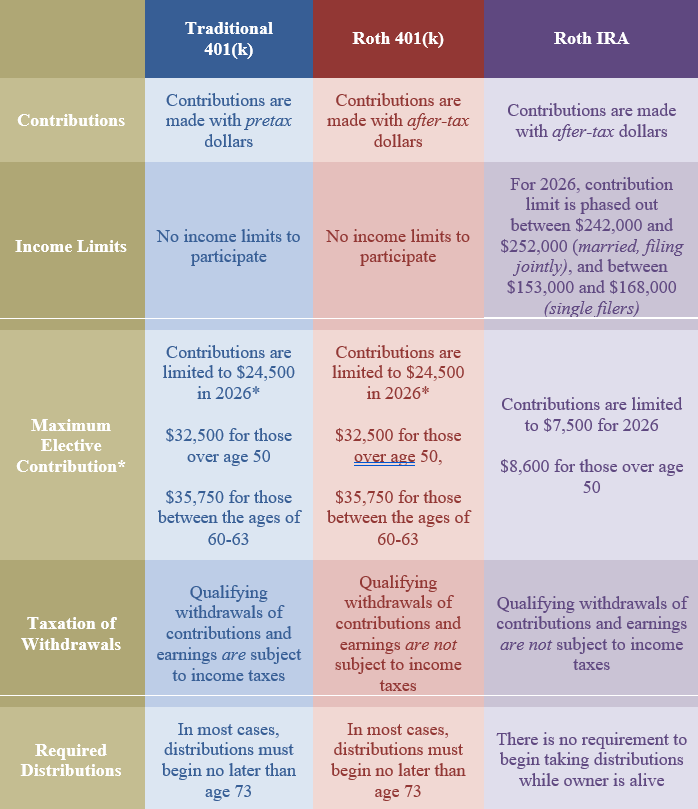
Roth IRA Categories Table

* This is an aggregate limit by individual rather than by plan. The total of an individual’s aggregate contributions to his or her traditional and Roth 401(k) plans cannot exceed the deferral limit – $24,500 in 2026 ($32,500 for those over age 50 and $35,750 for those between the ages of 60 and 63).

Source: IRS.gov, 2026

Roth 401(k) plans are subject to the same annual contribution limits as regular 401(k) plans – $24,500 for 2026; $32,500 for those over age 50. These are cumulative limits that apply to all accounts with a single employer; for example, an individual couldn’t save $24,500 in a traditional 401(k) and another $24,500 in a Roth 401(k).4

Another factor to consider is that employer matches are made with pretax dollars, just as they are with a traditional 401(k) plan. In a Roth 401(k), however, these matching funds accumulate in a separate account, which will be taxed as ordinary income at withdrawal.

Setting money aside for retirement can be part of a sound personal financial strategy. Deciding whether to use a traditional 401(k) or a Roth 401(k) often involves reviewing a wide range of factors. If you are uncertain about what is the best choice for your situation, you should consider working with a qualified tax or financial professional.

1. To qualify for the tax-free and penalty-free withdrawal of earnings, Roth 401(k) distributions must meet a five-year holding requirement and occur after age 59½. Tax-free and penalty-free withdrawals also can be taken under certain other circumstances, such as a result of the owner’s death or disability. Employer matches are pretax and not distributed tax-free during retirement. Once you reach age 73, you must begin taking required minimum distributions.
2. In most circumstances, you must begin taking required minimum distributions from your 401(k) or other defined contribution plan in the year you turn 73. Withdrawals from your 401(k) or other defined contribution plans are taxed as ordinary income, and, if taken before age 59½, may be subject to a 10% federal income tax penalty.
3. Roth IRA contributions cannot be made by taxpayers with high incomes. In 2026, the income phaseout limit is $168,000 for single filers, $252,000 for married filing jointly. To qualify for the tax-free and penalty-free withdrawal of earnings, Roth IRA distributions must meet a five-year holding requirement and occur after age 59½. Tax-free and penalty-free withdrawals also can be taken under certain other circumstances, such as a result of the owner’s death or disability. The original Roth IRA owner is not required to take minimum annual withdrawals.
4. IRS.gov, 2026
The content is developed from sources believed to be providing accurate information. The information in this material is not intended as tax or legal advice. It may not be used for the purpose of avoiding any federal tax penalties. Please consult legal or tax professionals for specific information regarding your individual situation. This material was developed and produced by FMG Suite to provide information on a topic that may be of interest. FMG, LLC, is not affiliated with the named broker-dealer, state- or SEC-registered investment advisory firm. The opinions expressed and material provided are for general information, and should not be considered a solicitation for the purchase or sale of any security. Copyright FMG Suite.

Retirement choices can feel intimidating. Choosing the right strategy can make all the difference.

As a small-business owner, figuring out retirement choices can be a little intimidating. How do you pick the most appropriate retirement plan for your business as well as your employees?
There are a number of choices when creating retirement plan strategies for you and your employees. Here, we will review three of the most popular for small businesses: SIMPLE-IRAs, SEP-IRAs, and 401(k)s. Read on below to learn more about each type of retirement plan.

This article is for informational purposes only and is not a replacement for real-life advice, so make sure to consult your tax, legal, and accounting professionals before implementing or modifying a retirement plan.

SIMPLE-IRAs. SIMPLE stands for Savings Incentive Match Plan for Employees. This is a traditional IRA that is set up for employees and allows both employees and employers to contribute. If you’re an employer of a small business who needs to get started with a retirement plan, a SIMPLE-IRA may be for you. SIMPLE-IRA’s provide some degree of flexibility in that employers can choose to either offer a matching contribution to their employees’ retirement account or make nonelective contributions. In addition, employees can choose to make salary reduction contributions to their own retirement account. Some small business owners opt for a SIMPLE-IRA because they find the maintenance costs are lower compared with other plans.1

Distributions from SIMPLE-IRAs are taxed as ordinary income, and if taken before age 59½, may be subject to a 10% federal income tax penalty. Generally, once you reach age 73, you must begin taking required minimum distributions.

For a business to use a SIMPLE-IRA, it typically must have fewer than 100 employees and cannot have any other retirement plans in place.1

SEP-IRAs. SEP plans (also known as SEP-IRAs) are Simplified Employee Pension plans. Any business of any size can set up one of these types of retirement plans, including a self-employed business owner. Like the SIMPLE-IRA, this type of retirement plan may be an attractive choice for a business owner because a SEP-IRA does not have the start-up and operating costs of a conventional retirement plan. This is a type of retirement plan that is solely sponsored by the employer, and you must contribute the same percentage to each eligible employee. Employees are not able to add their own contributions. Unlike other types of retirement plans, contributions from the employer can be flexible from year to year, which can help businesses that have fluctuations in their cash flow.2

Much like SIMPLE-IRAs, SEP-IRAs are taxed as ordinary income, and if taken before age 59½, may be subject to a 10% federal income tax penalty. Generally, once you reach age 73, you must begin taking required minimum distributions.

401(k)s. 401(k) plans are funded by employee contributions, and in some cases, with employer contributions as well. In most circumstances, you must begin taking required minimum distributions from your 401(k) or other defined contribution plan in the year you turn 73. Withdrawals are taxed as ordinary income, and, if taken before age 59½, may be subject to a 10% federal income tax penalty.1

1. IRS.gov, 2026
2. Investopedia.com, November 27, 2025
The content is developed from sources believed to be providing accurate information. The information in this material is not intended as tax or legal advice. It may not be used for the purpose of avoiding any federal tax penalties. Please consult legal or tax professionals for specific information regarding your individual situation. This material was developed and produced by FMG Suite to provide information on a topic that may be of interest. FMG, LLC, is not affiliated with the named broker-dealer, state- or SEC-registered investment advisory firm. The opinions expressed and material provided are for general information, and should not be considered a solicitation for the purchase or sale of any security. Copyright FMG Suite.

Getting the instruments of your retirement to work in concert may go far in realizing the retirement you imagine.

An orchestra is merely a collection of instruments, each creating a unique sound. It is only when a conductor leads them that they produce the beautiful music imagined by the composer.

The same can be said about your retirement strategy.

The typical retirement strategy is built on the pillars of your 401(k) plan, your Traditional IRA, and taxable savings. Getting the instruments of your retirement to work in concert has the potential to help you realize the retirement you imagine.1

Hierarchy of Savings

Maximizing the effectiveness of your retirement strategy begins with understanding the hierarchy of savings.

If you’re like most Americans, the amount you can save for retirement is not unlimited. Consequently, you may want to make sure that your savings are directed to the highest priority retirement funding options first. For many, that hierarchy begins with the 401(k), is followed by a Traditional IRA and, after that, put toward taxable savings.

You will then want to consider how to invest each of these savings pools. One strategy is to simply mirror your desired asset allocation in all retirement accounts.2

Another approach is to put the income-generating portion of the allocation, such as bonds, into tax-deferred accounts, while using taxable accounts to invest in assets whose gains come from capital appreciation, like stocks.3

Withdrawal Strategy

When it comes to living off your savings, you’ll want to coordinate your withdrawals. One school of thought recommends that you tap your taxable accounts first so that your tax-deferred savings will be afforded more time for potential growth.

Another school of thought suggests taking distributions first from your poorer performing retirement accounts, since this money is not working as hard for you.

Finally, because many individuals have both traditional and Roth IRA accounts, your expectations about future tax rates may affect what account you withdraw from first. (If you think tax rates are going higher, then you might want to withdraw from the traditional before the Roth). If you’re uncertain, you may want to consider withdrawing from the traditional up to the lowest tax bracket, then withdrawing from the Roth after that.4

In any case, each person’s circumstances are unique and any strategy ought to reflect your particular risk tolerance, time horizon, and goals.

1. “Under the SECURE Act, in most circumstances, you must begin taking required minimum distributions from your 401(k), Traditional IRA, or other defined contribution plan in the year you turn 73. Withdrawals from your 401(k), Traditional IRA or other defined contribution plans are taxed as ordinary income, and if taken before age 59½, may be subject to a 10% federal income tax penalty. 401(k) plans and IRAs have exceptions to avoid the 10% withdrawal penalty, including death and disability. Contributions to a traditional IRA may be fully or partially deductible, depending on your individual circumstances.
2. Asset allocation is an approach to help manage investment risk. Asset allocation does not guarantee against investment loss.
3. The market value of a bond will fluctuate with changes in interest rates. As rates rise, the value of existing bonds typically falls. If an investor sells a bond before maturity, it may be worth more or less than the initial purchase price. By holding a bond to maturity an investor will receive the interest payments due plus his or her original principal, barring default by the issuer. Investments seeking to achieve higher yields also involve a higher degree of risk. The return and principal value of stock prices will fluctuate as market conditions change. And shares, when sold, may be worth more or less than their original cost.
4. Roth IRA contributions cannot be made by taxpayers with high incomes. To qualify for the tax-free and penalty-free withdrawal of earnings, Roth IRA distributions must meet a five-year holding requirement and occur after age 59½. Tax-free and penalty-free withdrawal can also be taken under certain other circumstances, such as a result of the owner’s death. The original Roth IRA owner is not required to take minimum annual withdrawals.
The content is developed from sources believed to be providing accurate information. The information in this material is not intended as tax or legal advice. It may not be used for the purpose of avoiding any federal tax penalties. Please consult legal or tax professionals for specific information regarding your individual situation. This material was developed and produced by FMG Suite to provide information on a topic that may be of interest. FMG, LLC, is not affiliated with the named broker-dealer, state- or SEC-registered investment advisory firm. The opinions expressed and material provided are for general information, and should not be considered a solicitation for the purchase or sale of any security. Copyright FMG Suite.

One or the other? Perhaps both traditional and Roth IRAs can play a part in your retirement plans.

Traditional Individual Retirement Accounts (IRAs), which were created in 1974, are owned by roughly 41 million U.S. households. And Roth IRAs, created as part of the Taxpayer Relief Act in 1997, are owned by nearly 32 million households.1

Both are IRAs. And yet, each is quite different.

Up to certain limits, traditional IRAs allow individuals to make tax-deductible contributions to their account(s). Distributions from traditional IRAs are taxed as ordinary income, and if taken before age 59½, may be subject to a 10% federal income tax penalty. Generally, once you reach age 73, you must begin taking required minimum distributions.2,3

For individuals covered by a retirement plan at work, the deduction for a traditional IRA in 2024 is phased out for incomes between $123,000 and $143,000 for married couples filing jointly and between $77,000 and $87,000 for single filers.4

Also, within certain limits, individuals can make contributions to a Roth IRA with after-tax dollars. To qualify for a tax-free and penalty-free withdrawal of earnings, Roth IRA distributions must meet a five-year holding requirement and occur after age 59½.

Like a traditional IRA, contributions to a Roth IRA are limited based on income. For 2024, contributions to a Roth IRA are phased out between $230,000 and $240,000 for married couples filing jointly and between $146,000 and $161,000 for single filers.4

In addition to contribution and distribution rules, there are limits on how much can be contributed each year to either IRA. In fact, these limits apply to any combination of IRAs; that is, workers cannot put more than $7,000 per year into their Roth and traditional IRAs combined. So, if a worker contributed $4,000 in a given year into a traditional IRA, contributions to a Roth IRA would be limited to $3,000 in that same year.4

Individuals who reach age 50 or older by the end of the tax year can qualify for “catch-up” contributions. The combined limit for these is $8,000.4

Both traditional and Roth IRAs can play a part in your retirement plans. And once you’ve figured out which will work better for you, only one task remains: open an account.5

Features of Traditional and Roth IRAs

Traditional v Roth IRA

* Up to certain limits
** Distributions from traditional IRAs are taxed as ordinary income, and if taken before age 59½, may be subject to a 10% federal income tax penalty. Generally, once you reach age 73, you must begin taking required minimum distributions.
*** To qualify, Roth IRA distributions must meet a five-year holding requirement and occur after age 59½.

1. ICI.org, February 2023
2. IRS.gov, 2024. In most circumstances, once you reach age 73, you must begin taking required minimum distributions from a Traditional Individual Retirement Account (IRA). You may continue to contribute to a Traditional IRA past age 70½ as long as you meet the earned-income requirement.
3. Up to certain limits, traditional IRAs allow individuals to make tax-deductible contributions into their account(s). Distributions from traditional IRAs are taxed as ordinary income, and if taken before age 59½, may be subject to a 10% federal income tax penalty. Generally, once you reach age 73, you must begin taking required minimum distributions.
4. IRS.gov, 2024
5. The Tax Cuts and Jobs Act of 2017 eliminated the ability to “undo” a Roth conversion.
The content is developed from sources believed to be providing accurate information. The information in this material is not intended as tax or legal advice. It may not be used for the purpose of avoiding any federal tax penalties. Please consult legal or tax professionals for specific information regarding your individual situation. This material was developed and produced by FMG Suite to provide information on a topic that may be of interest. FMG Suite is not affiliated with the named broker-dealer, state- or SEC-registered investment advisory firm. The opinions expressed and material provided are for general information, and should not be considered a solicitation for the purchase or sale of any security. Copyright FMG Suite.
css.php